Study Demo
YouTube upload: March 12, 2026
First Big Red Button VR Study Demo
This demonstration presents the inaugural Big Red Button Institute virtual reality study on button-pressing behavior under conditions of maximal autonomy and minimal task demand.
- Participants are immersed in a controlled virtual environment with a single large red button.
- A standardized audio track guides the session while preserving open-ended interaction.
- Pressing and non-pressing are treated as methodologically valid outcomes.
The prototype is used to tune instruction cadence, button visibility, and the general atmosphere of button-adjacency before formal study deployment.
Theoretical Framework
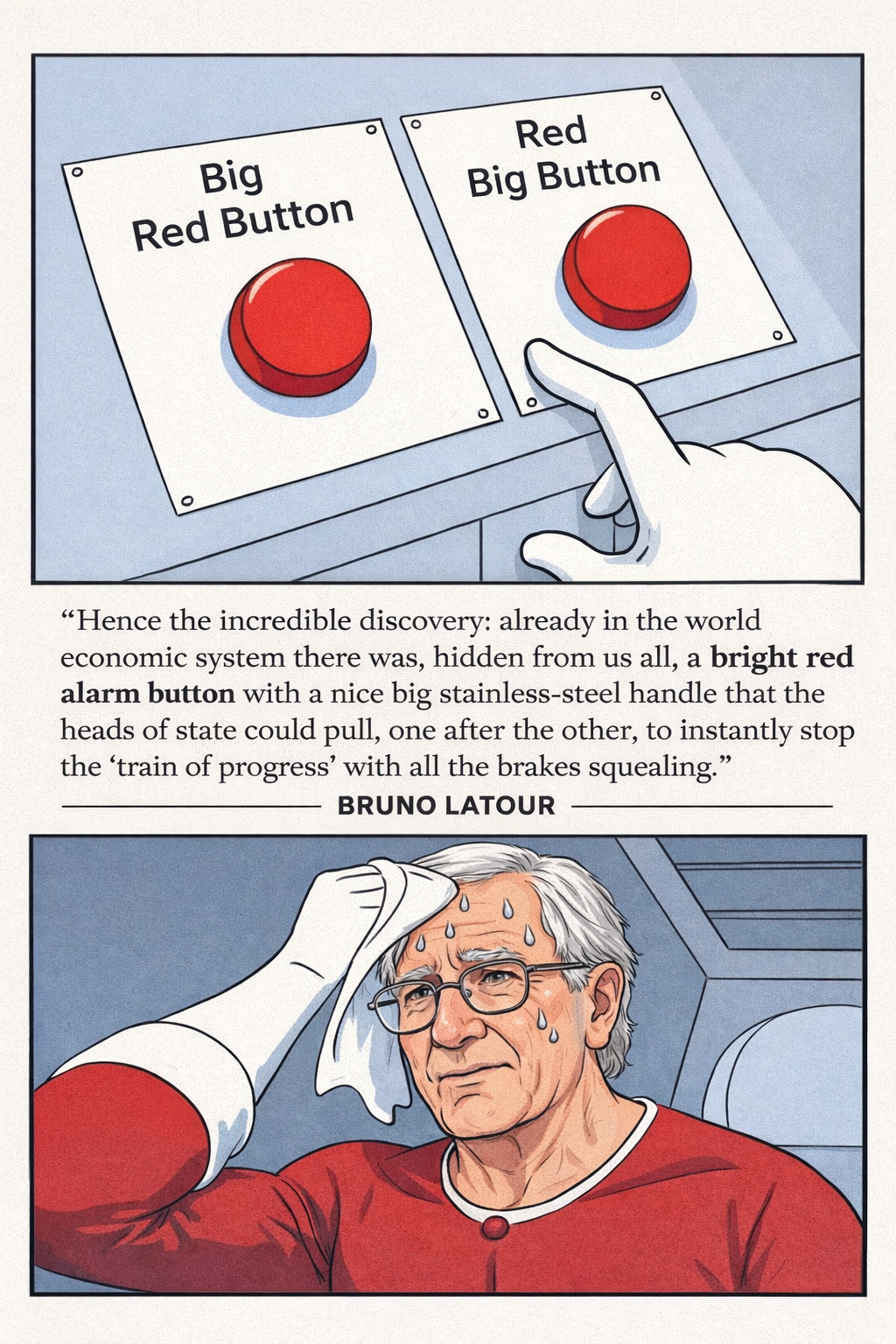
Following the Latour comic panel above, BRB treats the red button as both object and provocation: a device that converts collective thought into measurable action.
If the world already contains such buttons — hidden in plain sight, charged with social meaning, and capable of reorganizing collective attention — then the public question is straightforward: what happens when anyone can press?
BRB approaches this as a practical and conceptual problem. What counts as a press? Which design variables alter pressing behavior? How does repeated pressing change the public atmosphere of a place?
Research Divisions
I. Temporal Complexity Laboratory
Our flagship program models inter-press intervals with tools from information theory and nonlinear dynamics.
- Kolmogorov complexity of inter-press intervals: measuring compressibility versus apparent randomness in collective pressing sequences.
- Entropy dynamics: tracking shifts in press-rate distributions across hourly, weekly, and seasonal windows.
- Recurrence analysis: identifying phase transitions in public behavior as installations mature in place.
II. Ethnography of Pressability
Qualitative teams conduct interviews and participant observation on the lived experience of pressing and choosing not to press.
- Motivational profiles: curiosity, ritual, improvisation, group contagion.
- Narrative forms: how people describe the moment before and after contact.
- Spatial function: whether the button becomes a landmark, meeting point, or local folklore generator.
III. Button Design Phenomenology
In collaboration with designers and haptic engineers, we study how form and feel alter behavior.
- Chromatic affordance: comparative studies on the semiotic force of red.
- Protrusion geometry: how height and curvature affect invitation strength.
- Resistance curves and click acoustics: force, sound, and satisfaction as linked variables.
IV. Socioeconomic Impact Assessment
BRB measures civic and commercial spillover effects around installations in partnership with municipal actors.
- Button-adjacent businesses and curiosity traffic patterns.
- Dwell-time changes in plazas and transit nodes.
- Development of the Button Economic Multiplier Index (BEMI) for policy planning.
V. Critical Button Studies
Our humanities unit runs systematic literature reviews across design theory, STS, media archaeology, and philosophy of action.
- Genealogies of emergency aesthetics and the cultural authority of redness.
- Affordance theory revisited: from perceived invitation to enacted compulsion.
- Comparative studies of pressability across cultural and infrastructural contexts.
VI. Sonic Residencies Program
We commission composers and musicians to produce one-second sonic signatures for the button press.
- Monthly guest works turn each press into a micro-performance.
- Residents include experimental producers, voice artists, and field recordists.
- Core question: if a button had a voice, who should compose it?
Methodological Framework
Our analysis pipeline adapts complexity measures from computational neuroscience and consciousness research to button-press time series.
Entropy and Algorithmic Complexity
- Sample entropy / approximate entropy: quantifies unpredictability in inter-press intervals.
- Lempel-Ziv complexity: tests how compressible collective press sequences are over time.
- Permutation entropy: tracks ordinal pattern structure rather than raw magnitude.
Fractal and Scale-Free Dynamics
- DFA (alpha exponent): estimates long-range temporal correlations and memory effects.
- Hurst exponent: distinguishes persistent trends from anti-persistent reversals.
- Multifractal DFA: captures heterogeneity in scaling across fluctuation sizes.
Dynamical Systems and State Transitions
- Recurrence quantification analysis: characterizes determinism, laminarity, and regime shifts.
- Lyapunov exponents: tests sensitivity to initial conditions in crowd-level behavior.
- Correlation dimension: estimates the effective dimensionality of the generating process.
Criticality Signatures
- Power spectral density slope: tests for 1/f-like structure in press dynamics.
- Avalanche analysis: evaluates burst sizes and durations for scale-invariant behavior.
- Branching parameter: estimates whether one press statistically recruits subsequent presses.
Networked Multi-Button Systems
- Transfer entropy: measures directed information flow between button locations.
- Integrated-information proxies: tests whether distributed button streams act as a coupled whole.
If neural activity at peak complexity often sits near criticality, BRB asks the corresponding civic question: does the crowd?
Scientific Advisory Board: Reggie Watts — musician, comedian, and theorist of nonsense-as-method.
Participate
BRB is currently seeking installation sites, partner institutions, resident artists, and dedicated pressers.
If you encounter a Big Red Button in your city, your contribution enters the dataset, shifts the model, and helps define the next phase of pressability research.
Press, and be counted.
Publications
Big Red Button: a pressing issue
This is our first publication and framing document for the BRB program.
For this publication cycle, we are actively searching for collaborations with researchers, institutions, artists, and civic partners.